Catnip and plush cat toys
Catnip and plush cat toys, built to your brief
Soft-bodied cat toys with an attractant held inside, shaped for carrying, kicking and batting. Catnip, silvervine and valerian fills, in bodies cut to your artwork and packed under your own label. Made as OEM runs to your design or as ODM adaptations of shapes we already develop.
The build
What a catnip toy actually is
A catnip toy is a fabric body with an attractant inside it, and the design question is how the two are kept together. That single decision changes the pattern, the filling line and how long the product works after the customer opens it.
The shell
Short-pile plush, fleece or a structured knit, cut to a shape a cat grips. The shell has to be tight enough to hold the fill in and open enough to let the scent through, which is a fabric specification before it is a design one.
The pouch
The attractant normally sits in an inner pouch rather than loose in the body, so the fill stays where it was placed. Where the pouch is not specified, the fill migrates to one end and the toy stops working in that spot.
The closure
Closed seams keep the fill in for the life of the toy. A refillable compartment uses an opening instead, which has to close reliably — it is the part that decides whether a refillable product is worth making at all.
Attractants
Four fills, and what each one is for
The attractant is the part of a cat toy that a buyer is least able to verify and most likely to be asked about. Here is what each option is, and where it normally belongs in a range.
| Fill | What it is | Where it suits | What to watch |
|---|---|---|---|
| Catnip | Dried leaf and flower of the catnip plant, milled to a grade and held in an inner pouch. | The default for a general range, because shoppers recognise it and it needs no explanation on the packaging. | Response varies between cats, and potency depends on the grade and on how the pouch is sealed. Both are agreed at sampling. |
| Silvervine | A separate plant whose dried fruit and leaf are used as an attractant, often milled into a powder. | Ranges aimed at cats that show little interest in catnip, or at markets where silvervine is already the expected name. | It is a different product with a different supply chain, so it is quoted as its own line item rather than as a swap for catnip. |
| Valerian | A root used as an alternative attractant, usually combined with catnip rather than used alone. | Refillable lines and products sold on a strong response, where the smell is part of the proposition. | It carries a pronounced smell that consumers either accept or do not. That is a positioning decision before it is a manufacturing one. |
| No attractant | Fabric body only, with the play coming from shape, movement, a crinkle layer or a sound device. | Ranges where the packaging cannot carry an attractant claim, or where the toy is part of a teaser or electronic line. | It removes a labelling question entirely, which is often the reason this option is chosen for export ranges. |
Shapes and materials
The shapes this line is cut to
Catnip bodies are mostly flat or lightly filled, because a cat grip is different from a dog bite: the toy is held and kicked rather than shaken apart. These are the fabrics and the silhouettes the line is normally built from.
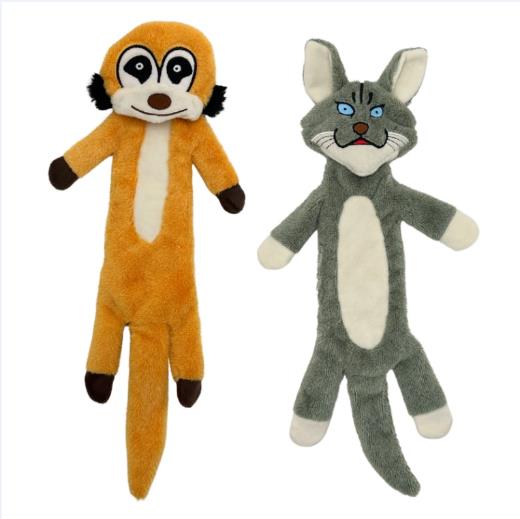
Flat body
Panels joined and edge-bound with a small pouch inside. The shape a cat carries, and the cheapest body to build with a catnip fill.
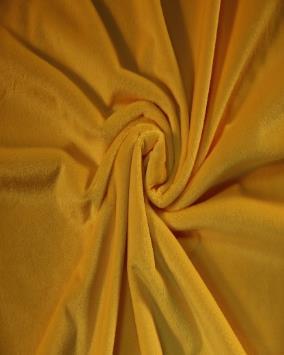
Short-pile plush
Tight enough to hold a fill in, open enough to let the scent through. Pile height is specified with the fill, not separately.
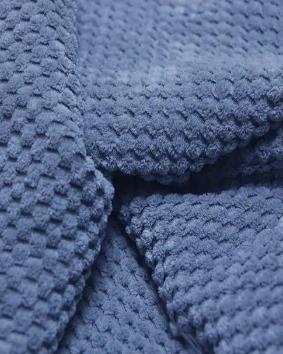
Structured knit
Corduroy, piqué and waffle surfaces give a lightly filled body its shape without adding weight or filling cost.
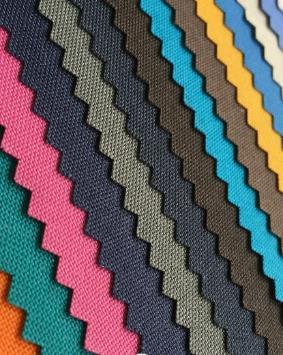
Colour matching
Colour is approved against a swatch rather than named. Cat ranges are often colour-led, which makes this the step worth getting right first.
Bodies are shown from current production. Catnip lines are made and shipped alongside the dog range; if you are specifying a shape, ask and we will send photographs of the constructions you are considering rather than a representative one.
Fill formats
Three ways to hold the attractant
This is the decision that most changes the product, and it is made before the first sample rather than after it. Each format below sits at a different point on cost, reuse and how long the toy keeps working.
Loose in the body
The attractant goes into the body with the fill. The simplest and cheapest to assemble, and the one that disperses most through the fabric — but it settles to one end over time and cannot be replaced.
Sealed inner pouch
A stitched pouch holds the fill in place inside a closed body. Costs one more operation and holds its performance far longer, because the fill stays where it was placed rather than migrating to the tail.
Refillable compartment
An opening, usually a hook-and-loop flap or a zip, with a compartment behind it. The product is reusable rather than disposable, which changes how it is merchandised — and adds a closure that has to be tested as a part in its own right.
A refillable line needs its refill pack specified at the same time, or the product ships without anything to refill it with. That is a separate SKU with its own packaging and its own minimum.
How it is made
Four operations on a catnip body
The build shares its cutting and stitching with the plush dog range. What it adds is a filling step with its own handling rules and a seal check that has no equivalent on a dog toy.
-
STAGE 01
Pattern and cutting
Body panels are cut, plus the pouch panels for the attractant where one is specified. On a flat body the silhouette is carried entirely by the cut, so the pattern is the design.
-
STAGE 02
Pouch assembly
The attractant pouch is stitched and filled before the body is closed around it. Pouch size is set against the fill quantity, and both are agreed at sampling rather than at the filling table.
-
STAGE 03
Body closure and features
The body is closed around the pouch, faces and features are embroidered, and stress points are reinforced. Embroidered features are used rather than applied parts, for the same reason as on the dog range.
-
STAGE 04
Seal and finish check
Each unit is checked for a closed seam and a correctly seated pouch before packing. This is the check with no equivalent on a dog toy: a catnip toy with a failed seal is not a slightly worse toy, it is a toy that does nothing.
Specification
What a catnip toy specification has to state
Six fields decide almost everything about a catnip line — the cost, the sampling time and how the product behaves once it is opened. A first message carrying these gets a quotation rather than an estimate.
Shape and size
The silhouette and the finished dimensions. On a flat body this is the whole design, so a sketch or a reference photograph is more useful here than a written description.
Attractant
Which fill, at what quantity, and in which format. The three are one decision: a fill quantity that works loose in a body will not suit a small sealed pouch.
Fill weight
How much fibre, if any, around the pouch. A cat body runs much lighter than a dog body of the same size, and this is the field where that is set.
Shell fabric
Fabric, pile height and colourway, plus print if the design is printed rather than pieced. The fabric has to hold the fill in while letting the scent through.
Branding
Woven label, embroidered logo or printed tag, and where it sits. Applied plastic parts are avoided — they are the first thing to come away from a soft body.
Packaging and destination
Header card, polybag, carton count and shipping marks, plus the destination market. Attractant-filled products can carry labelling requirements that vary by market, so this is confirmed before sampling.
What buyers ask about this line
Quote a catnip or plush cat toy line
Send the shape, the attractant and its format, and the packaging requirement. You will get the applicable minimum order quantity, the sampling date and the compliance file set in the same reply. Related reading: the cat toy range and the buying guides.