
Dog toys
Dog toys manufactured to your specification
Five constructions — plush, squeaky, no-stuffing and crinkle, chew, and interactive or treat-dispensing — built as OEM runs to your artwork or as ODM adaptations of patterns we already develop. Each one is quoted with its fabric, fill, insert and packaging spec attached.
Constructions
The five dog toy constructions
These are not marketing categories, they are different production lines with different materials, different failure points and different minimums. A dog range usually carries three or four of them, and which ones you choose decides most of what follows.
Plush
A woven plush shell over polyester fill, with embroidered or appliqué features. The work sits in the pattern: seam placement, stress points and how a printed design reads across a curved surface.
Squeaky
A plush or bonded-fleece shell over an inner housing that carries the sound device. Squeaker grade and seating are fixed at sampling, because that is what decides whether the toy still sounds like itself after a week.
No-stuffing and crinkle
Layered fabric panels with no loose fill, optionally with a crinkle film between the layers. Lighter to ship, cheaper to make, and with nothing to pull out of a torn seam — the reason most buyers add this at the value end of a range.
Chew
Moulded TPR, TPE and rubber bodies, or layered woven fabric over a reinforced core. Moulded parts carry tooling, so a new shape costs more at the start and less per unit afterwards.
Interactive and treat-dispensing
A mechanism inside a sealed housing: motion, sound, or a cavity that releases treats as the dog works at it. The housing has to be specified alongside the mechanism, because the two are moulded together.
The catalogue itself
Every construction above is drawn from the live catalogue, so the shapes, colourways and sizes currently in production are browsable rather than described. New arrivals and best sellers are the fastest routes in.
In production
What the dog range looks like made up
Photographs from current production, one per construction. What is visible is the pile, the seam line, the moulded surface and the trim — the four things a rendering or a specification sheet cannot show you.
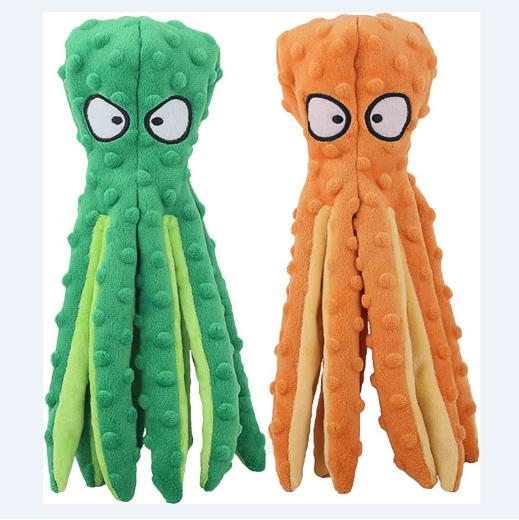
Plush, printed pile
A dotted print carried across the head and legs. The seam runs where the print breaks, so pattern and placement are specified together.
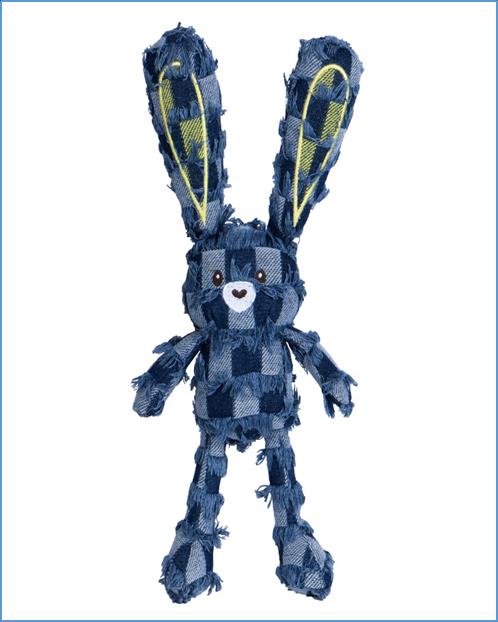
Squeaky, fleece shell
Frayed fringing is cut after stitching, so it is a finishing operation rather than a pattern feature, and it behaves differently on every fabric.
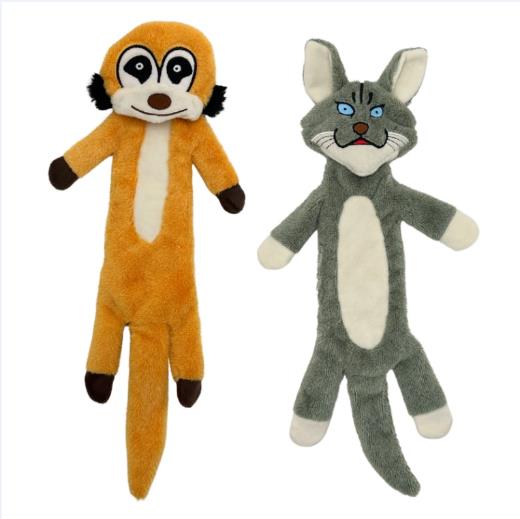
No-stuffing, flat body
Two flat panels, edge-bound, with nothing between them. The shape holds only because the fabric was chosen to hold it.
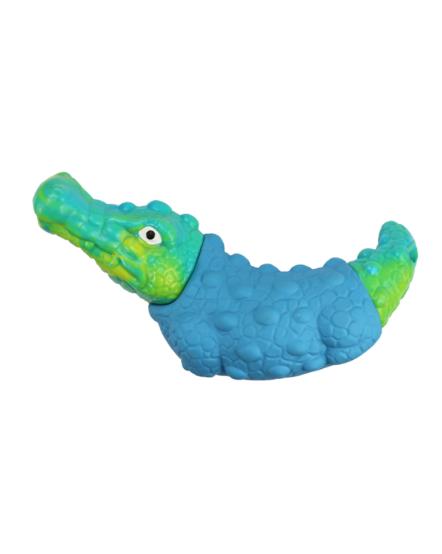
Chew, moulded body
Two-shot moulding in two colours from one tool. The dotted surface is part of the tool, not an applied finish.
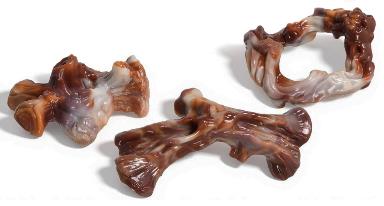
Chew, shape family
One material, three silhouettes. Adding a shape to a family is a tooling decision, not a design one.
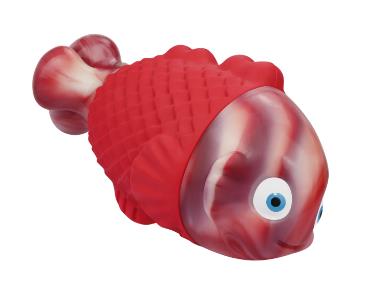
Squeaky, moulded latex
The softest of the squeaky builds. The sound device sits inside a moulded shell, so it cannot be photographed from outside on a finished unit.
How it is made
From pattern to packed carton
A stitched dog toy passes through four operations. Moulded chew and interactive lines replace the first three with tooling and moulding, then rejoin at finishing. The order below is the stitched route, because it is the one most dog ranges are built on.
-
STAGE 01
Pattern and cutting
Your artwork becomes a pattern, the pattern is nested against the fabric width, and the panels are cut. Nesting decides the fabric yield, so a small change to a shape can move the material cost of the whole order.
-
STAGE 02
Stitching and assembly
Panels are joined inside out, features are embroidered or appliquéd, and stress points at ears, limbs, tails and attachment loops are reinforced. This is where a toy is either going to survive or not.
-
STAGE 03
Filling and insert seating
Fibre fill is graded by density, then the squeaker or rattle is seated and the seam is closed around it. Insert position is a specification item, not a workshop choice — where the device sits is where the toy is squeezed.
-
STAGE 04
Finishing and function check
Trimming, fringing, edge binding and label attachment, then a function check of the sound device on the finished unit before it is packed. Appearance checks and function checks are separate passes.
Each stage has a defined inspection point attached to it. The full routine is set out on the quality control and testing page, and the workshop itself is on the factory page.
Specification
What a dog toy specification has to state
A first message that carries these fields gets a quotation rather than an estimate. Anything missing is quoted as an assumption, and an assumption is the most expensive line on a pet toy order.
Quantity
Total units, and how they split across sizes and colourways. The split matters more than the total: a 12,000-unit order across four colourways is not the same job as 12,000 in one.
Construction and size
Which of the five constructions, the finished dimensions, and the weight class the toy is aimed at. Size grading is quoted as a multiplier on one pattern unless the shapes differ.
Fabric and fill
Shell fabric and pile height for plush and squeaky builds, or compound and hardness for moulded ones. Fill density where the toy has to hold a shape, and no-stuffing where it must not.
Sound and motion
Squeaker grade, count and placement; rattle inserts; mechanism type and control layout for interactive lines. These are the parts most likely to be swapped silently, so they belong in the specification.
Branding
Where your logo sits and how it is applied — embroidered, woven label, moulded into the tool, or printed. A moulded logo has to be in the tool from the first shot, not added later.
Packaging and destination
Header card, hang tag, polybag with or without a suffocation warning, carton count and shipping marks, plus the destination market. The destination decides which test reports the order carries.
The sampling and product development page covers what happens to these fields once they arrive, and the buying guides cover how to write the brief they go into.
Customisation
What changes, and what it costs you
Every field below can be changed on a dog toy. The useful question is not whether it can be, but which changes move the tooling, the sampling rounds or the minimum order quantity — so each one says so.
Customisation points on a dog toy
OEM and ODM- Colourway
- Changing colour on a stitched toy costs a fabric lot; on a moulded part it can cost a tool if the colour is moulded in rather than painted. Colour is matched to your artwork against an approved swatch, not by name.
- Size grading
- The same pattern scaled across a size run, so one design covers small breeds through large dogs. This is the cheapest way to widen a range, because it adds no new shape.
- Fabric and pile
- Shell fabric, pile height and surface texture. Pile height changes both the hand feel and how a print reads on the finished toy, so the two are specified together rather than in sequence.
- Fill and sound
- Fibre density, recycled fibre, crinkle film in place of a mechanical device, squeaker grade and count, or a rattle. Removing a sound device entirely is a legitimate specification, not a shortfall.
- Trim and hardware
- Rope, webbing, binding tape, appliqué and embroidered features. Applied plastic parts are avoided on chew builds in favour of stitched features, because an applied part is where a chew toy fails first.
- Packaging
- Header cards, hang tags, polybags, carton counts and shipping marks produced to your file. Packaging is quoted with the toy, because a header card is a second print job with its own dates.
Where dog toys fail
The four places to check before you commit
Returns and complaints on dog toys cluster in the same four places whatever the construction. Reviewing these at sample stage costs nothing; finding them out at retail costs the range.
Seams at stress points
Ears, limbs, tails and attachment loops are pulled first. Double stitching and a reinforced anchor at each point is the difference between a toy that lasts a season and one that lasts a week.
Insert position
A squeaker seated near a seam will be worked loose; one seated off-centre will not sound when the dog squeezes the body. Position is agreed at sampling and held for bulk.
Applied parts
Plastic eyes, bells and clip-on trims are the parts that come away, and the ones a buyer will find in a photograph of a complaint. Embroidered features remove the failure rather than reduce it.
Fill escaping
Loose fibre fill is the visible consequence of a torn seam, and the reason no-stuffing constructions exist. If your market treats fill as a hazard, specify the construction rather than the marketing line.
Questions about pet toys that apply to every category rather than to dog toys specifically — MOQ, sampling, compliance, reorders — are answered on the FAQ page.
What buyers ask about this range
Start a dog toy range from a construction
Tell us the construction, the size run, the packaging format and the destination market. You will get the applicable minimum order quantity, the sampling date and the compliance file set in the same reply. Related reading: no-stuffing and crinkle constructions, chew toys and the buying guides.