
Chew toys
Pet chew toys built to a chewing strength you specify
Chew toys are the family where material choice decides whether the product survives its first week. Constructions are graded by chewing strength and body size, built from TPR, TPU, rubber, E-TPU, PP and TPE, and closed with reinforced seams at every stress point.
Chew range
Moulded surfaces, shot on white
The moulded range photographed straight, so the surface texture, the wall thickness at the edges and the size relationship between shapes can be judged from the images rather than from a description.
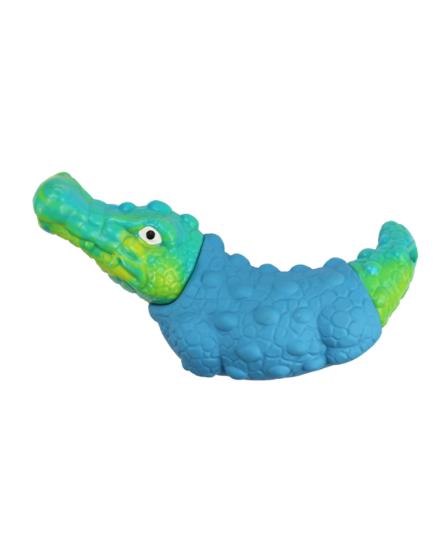
Crocodile, two-tone moulding
Body and head are moulded in two colours, so the joint between them is a moulding seam rather than a glue line. That seam is the first place a hard chewer works on.
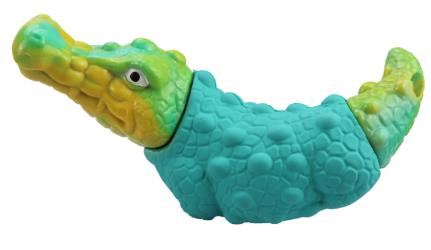
Scale texture
Raised bumps along the body give the jaw something to grip and vary the wall thickness. Texture depth is set in the tool, so it is fixed once the mould is cut.
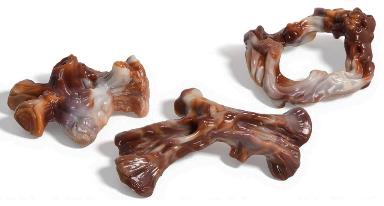
One compound, three shapes
The same marbled compound run in a ring, a bone and a knobbly upright. Keeping one compound across a range is what lets a buyer hold a colour match across the assortment.
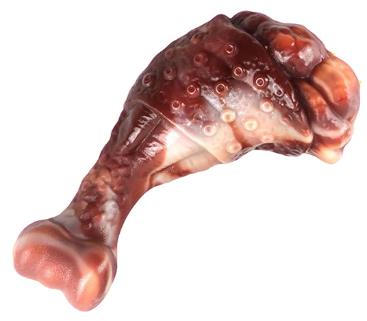
Bubble texture, bone end
A two-part moulding: a soft bubble-textured body bonded to a firmer bone end. Mixing two hardnesses in one toy is a durability decision, not a cosmetic one.
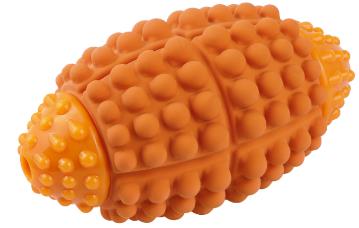
Nubbed ball
Rows of rounded nubs over a solid core, with a harder cap at the tip. Solid mouldings like this carry no seam along the play surface.
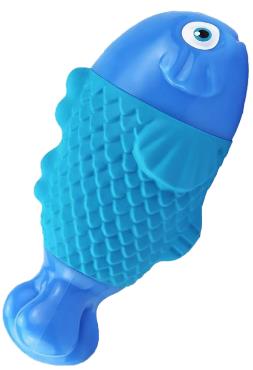
Fish, moulded fins
Fins and tail are formed in the same shot as the body, so there is no separate part to detach. Where a shape needs an added part instead, that part is where the toy will fail.
Construction split
Stitched or moulded: the first decision
A chew toy resists chewing in one of two ways. It can be stitched, so the resistance comes from the shell, the filling and the seams, or it can be moulded, so the resistance comes from one piece of polymer whose thickness and profile are the product. The two are built on different equipment, sampled differently, and priced on different things — which is why this is settled before material or shape.
| Question | Stitched construction | Moulded construction |
|---|---|---|
| Where the resistance comes from | Layered woven or heavy-knit shell, dense fill or a reinforced core, and seams doubled at the points a dog pulls from. | The material itself. Wall thickness, profile and compound hardness set how much the toy gives. |
| Where it fails | A seam, an attachment, or filling escaping through a torn panel. Failure is progressive and visible. | A chewed edge, or a thin section worn through. Failure is sudden once the surface goes. |
| What it can carry inside | Squeakers, crinkle film, a moulded core, rope-like appendages, a plush outer face on one side. | Nothing, as a rule. Where a sound device or treat cavity is needed it is moulded in as an additional feature, not added afterwards. |
| Softness and feel | Gives under pressure and reads as a soft toy, which suits a range that also carries plush. | Firm and unyielding, which is what a strong chewer is looking for. |
| What a size change costs | A new cut from the graded pattern. Fill weight is re-set per size and recorded. | Usually a new tool. That is the decision that makes a size run expensive on a moulded line. |
| What drives the minimum | Cutting, seam work and fill, plus the colourway count. No tooling unless a moulded part is added. | The tool, amortised across the first order, plus the material and the shot count. |
| Best suited to | Dogs that carry, shake and mouth rather than destroy; ranges that have to match plush products; toys where a soft or variable surface matters. | Strong chewers, products where the shape itself is the feature, and anything that has to hold treats or float. |
The line between the two is not absolute, and some of the most durable products deliberately cross it. A stitched shell with a moulded core, a two-shot part with a softer over-mould on the chewing face, and a textile body with rubberised edge panels are all built here — each one combines the two constructions rather than choosing between them. The materials section below covers what each polymer contributes once a moulded or part-moulded route has been chosen.
Chew toy selection
How a chew construction is chosen
Four variables decide whether a chew toy does what the buyer needs. They are settled together, because changing one moves the others.
Chewing strength
The primary variable. Hardness and wall thickness are set together so that a toy gives enough resistance for the intended chewer without becoming hard enough to damage teeth. The grade is agreed at sampling against the size and weight range you are buying for.
Size and shape
Shape decides how a dog holds the toy and which surfaces take the load. A bone, a ring and a ball made from the same polymer wear differently, so shape is treated as an engineering choice rather than a styling one.
Material family
TPR and TPE give a soft, flexible bite with good tear resistance. TPU and rubber take higher loads. PP suits rigid structural parts, and E-TPU gives a lightweight resilient foam element where weight matters.
Treat and play function
Where a chew toy also holds treats, dispenses or floats, that function adds a cavity, a wall or a seal to the build. Each one is a place the product can fail, so it is specified and tested as part of the assembly.
Material and durability
What each polymer gives a chew toy
These are the polymer families held for chew and hard-component production. The exact grade is chosen against the chewing strength the product is graded for, and confirmed on the specification sheet.
| Material | Full name | Where it is used |
|---|---|---|
| TPR | Thermoplastic rubber | Chew bodies and soft-grip mouldings |
| TPU | Thermoplastic polyurethane | Tough flexible parts that resist tearing |
| PP | Polypropylene | Rigid components and structural parts |
| E-TPU | Expanded thermoplastic polyurethane | Lightweight resilient foam elements |
| Rubber | Natural and synthetic rubber | High-resilience chew construction |
| TPE | Thermoplastic elastomer | Soft-touch overmoulding and flexible detail |
Browse the catalogue
Find the range by attribute
The live catalogue is browsable by the attributes below. A linked attribute opens a real catalogue or category page. An unlinked attribute is one the catalogue filters on, but it has no page of its own, so it is shown as plain text rather than as a control that would do nothing here.
Type
- Chew Toys
- Plush Toys
- Squeaky Toys
- Interactive Toys
- Cat Trees
Material
- Plush
- Polyester
- Wood
- TPR
- Silicone
- Cotton rope
Size
- Small
- Medium
- Large
- Custom Sizes
Holiday
Range entry points
Commercial terms
Where to go next
Attribute filtering itself runs in the live catalogue, not on this page. The pages here describe how each family is built and what a buyer specifies; the catalogue holds the products.
Chew toy specification questions
Next steps
Sample, quote, catalogue or a direct message
Every route below reaches the team that would quote and run the order. There is no sales desk in between.
Request a sample
Samples are available on this line. Send the construction, the size and the destination market, and we will confirm what can be sampled and when.
Request a quote
The quotation states the minimum order quantity, the sampling date and the compliance file set that applies to your line. Exact figures are named per line, never as a blanket number.
Request the catalogue
The product catalogue and the procurement guides are sent through the same request form, so that what you receive matches the range and the market you are buying for. There is no direct download link.
Message on WhatsApp
For a short question or a photograph of a reference product, WhatsApp reaches the same team. Messages outside China Standard Time are answered on the next working day.
Send the chew construction and the size range
Tell us the chewing strength, the size range and the destination market. Related reading: materials and process and the inspection chain.